Expressing Women’s Community, Identities and Strength through Quilting
Posted: 14 October, 2026
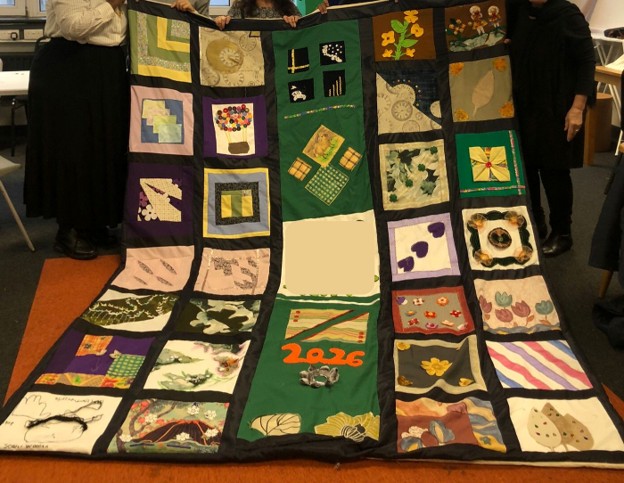
My research project involves working closely with a group of women refugees and asylum seekers in Belfast, Northern Ireland to understand the difficulties they face while trying to integrate and settle into their new lives. With the objective of giving these women more of a voice, I incorporated an arts project into the research. Approximately fifteen women joined in, self-selected from an ongoing weekly sewing group. The quilt was a natural evolution of this group’s work, allowing each woman to make her own square(s) individually. Once the individual piece was complete, they combined them into one larger cohesive piece that simultaneously represents diverse individual and collective experiences of life as a woman refugee or asylum seeker.
The participants chose quilting as a medium of expression because of the individual and collective elements, but also because it allowed them to learn and connect with an Irish tradition. These women asylum seekers and refugees settle in Belfast with a desire to become contributing members of society that know and respect local traditions. They demonstrated this by learning to quilt under the direction of an Irish quilter. As one facilitator explained, “quilting is quite an Irish thing, and such a strong part of our heritage. I’m sure they’ll have their own insight from ways that they make, but they wont be the same. I feel that there’s gonna be a good crossing and sharing of skills”. In this statement she calls attention to how quilting allowed for connection and collaboration not only between the women, but also with local tradition and community.
The project began in November 2025 and finished in February 2026. The organisation has large plastic tubs filled with donated fabric, threads, and accessories that the quilters sifted through, pulling out and experimenting with an assortment of fabrics, colors and textures. Using these selections, they designed their individual squares, piecing different fabrics and decorative elements together. As the weeks went by, finished squares began to pile up and in January together they laid out the pieces to determine their final position in the finsihed quilt. Once the final layout was established, the quilters connected the squares to one another with fabric and thread, mimicking the bonds created between each individual woman and her unique story through the process of quilt making.
The women were so enthusiastic about the project that in the end they made more squares than they were able to include in the final quilt. Many squares remain that will be used to either make a second quilt or to make bags in the near future.
Looking at the individuals squares, many are abstract or geometric combinations of colours and shapes. Several include flowers and hearts. A select few have more poignant messages that connect to findings in my broader research and deserve further attention.
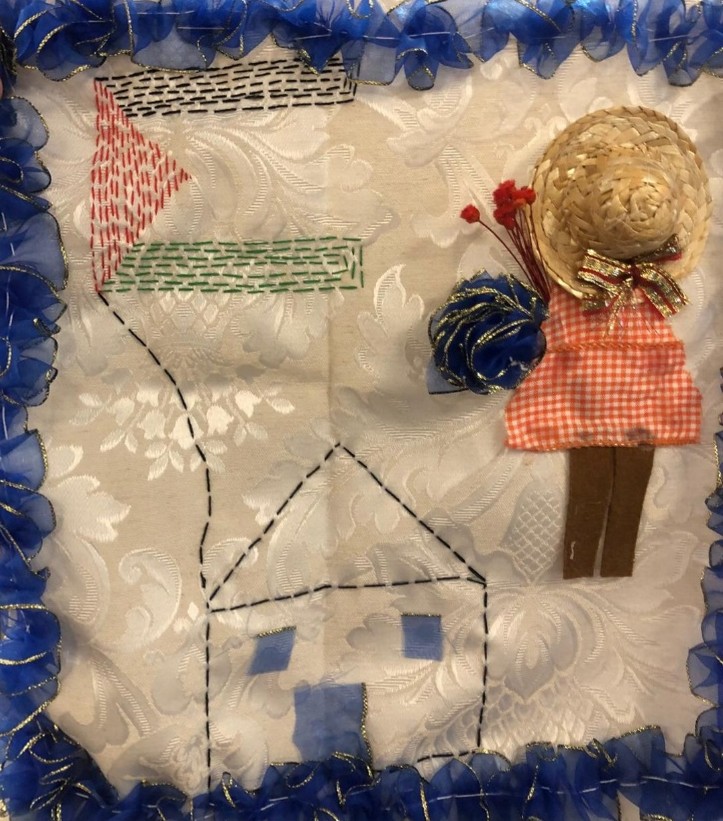
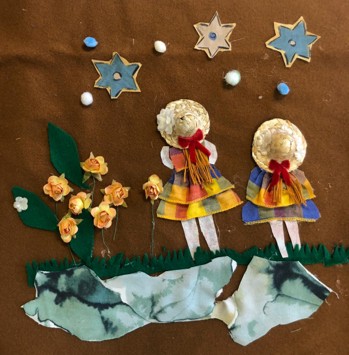
The first two panels (figures 2 and 3) appear to be aspirational, depicting hopes for the future. The first shows two girls standing among flowers and looking towards stars in the sky. The second shows a home with a Palestinian flag and a woman or girl alongside it. Together these two squares illustrate the importance women asylum seekers and refugees place upon home and family. The house represents a common desire they have for a sense of permanence and belonging. They strive for a type of integration that means adding on a Northern Ireland identity rather than replacing their prior identity. For this woman, she envisions herself as being a Northern Ireland Palestinian, celebrating both identities equally.
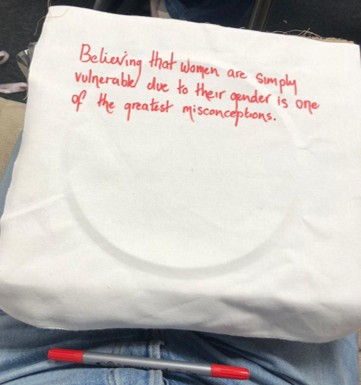
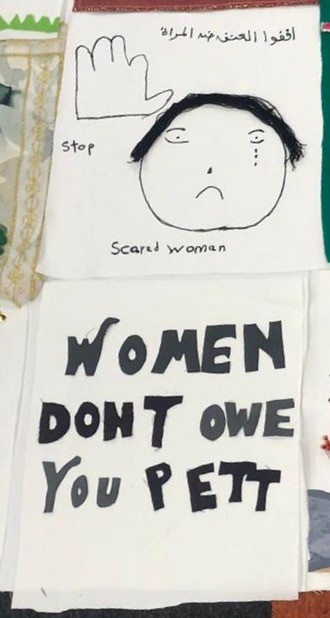
The second set of blocks (figures 4 and 5) depict something different – the gender-based violence and oppression these women have faced in the past and present. Figure 4 shows a handwritten message that “Believing that women are simply vulnerable due to their gender is one of the greatest misconceptions”. Figure 5 shows two connected panels, the first showing a woman’s face with tears running from one eye and a hand up making a “stop” motion. Above the picture the creator wrote “Stop violence against women” in Arabic, and in the second panel wrote “women don’t owe you pett” in English. Together these three panels highlight the gendered experiences of these women and the ongoing importance of these messages in their lives.
Together all of these panels paint a picture of the complexity in women asylum seekers’ and refugees’ lives. Many of these women have experienced some form of violence in their home countries, when traveling to their host country, and/or in Northern Ireland. In the face of these experiences they do not hide or retreat, but instead work together to try and improve things for themselves and their children. Like anyone, they aspire to a safe future where their children can enjoy nature and a home of their own, and where they all belong and contribute to the broader community. Taken as a whole, the quilt and leftover squares represent the past, present and future of its makers.
Additional Information:
For more detailed information on this research and these issues, please see the following publications:
About belonging and motherhood – A mother’s experience of asylum
About integration (free to all) – Valuing women’s spaces and communities: Refugee integration in hostile environments by Amanda Lubit
Book (free to all) – Life as a migrant Muslim woman in sectarian Northern Ireland by Amanda Lubit
Link to Profiles:
Amanda Lubit at DCU’s Institute for Research on Genders and Sexuality, and on LinkedIn, Researchgate and BlueSky