Public Health and the Arts and Humanities
Posted: 31 August, 2026
In this blog, Dr. Sophie Franklin tells us about how her DOROTHY research explores the role of the arts and humanities—particularly literature, language, and storytelling—in understanding violence as a public health issue, highlighting workshops and interdisciplinary collaborations that show how cultural perspectives can shape healthier communities.
The arts and humanities play an important role in improving health locally and globally. In 2019, Daisy Fancourt and Saoirse Finn’s WHO report, ‘What is the evidence on the role of the arts in improving health and well-being? A scoping review’ (2019), found that the arts can “affect the social determinants of health”, “support child development”, “encourage health-promoting behaviours”, “help to prevent ill health”, and “support caregiving”. An article in The Lancet from 2023 also found that investment in the arts (encompassing literature, culture, the performing arts, and the visual arts) “is linked to better public health outcomes, and governments need to be aware that any cuts to arts investment could probably have a negative effect on public health”.
My DOROTHY project traces a literary history of the “violence as contagious” narrative (the idea that violence acts like a contagious disease) from the nineteenth century to the present, to consider the role of storytelling and language in ongoing public health approaches to the reduction of violence. This involves considering the significance of literature and culture within conversations and policies seeking to tackle the social problem of interpersonal violence. Showcasing the importance of the arts and humanities and its impact on major social issues, including public health crises, is at the heart of my research.
Violence, Health, and the (Health) Humanities
As my research project considers understandings of health, disease, and the medicalisation of violence, my work engages with the health humanities as a field. The health humanities is a relatively new field that considers how the arts and humanities can illuminate and be applied to ideas of health and wellbeing. The health humanities focuses both on the role of the arts in our everyday and long-term health, as well as on challenging normative understandings of health – even something as seemingly simple as what it means to be healthy. Researchers have often viewed the health humanities as an inclusive field, driven by interests in social injustice and inequality.
In January 2026, I hosted a workshop for colleagues at University College Dublin who work in the areas of violence, health, and the humanities. I wanted to create a space for UCD colleagues to meet and share their common interests in these topics. There were flash talks on a range of topics: from Marian Keyes’s fiction as policy critique to representations of the monster in popular culture; and from depictions of alcohol consumption and gendered violence in colonial European Empires to complicating the meaning of humanity in the practice of animal slaughter in colonial Nigeria. We ended with a roundtable of experts who discussed the roles of violence and health in their own research. Dr Pascale Baker talked about negative portrayals of Mexico as a “diseased” nation through its associations with narco-culture; Dr Ailise Bulfin introduced her European Research Council project on the social impact of representations of child sexual violence in twenty-first-century culture; and Dr Alice Mauger reflected on her work on nineteenth-century Irish asylums and their ongoing legacies.
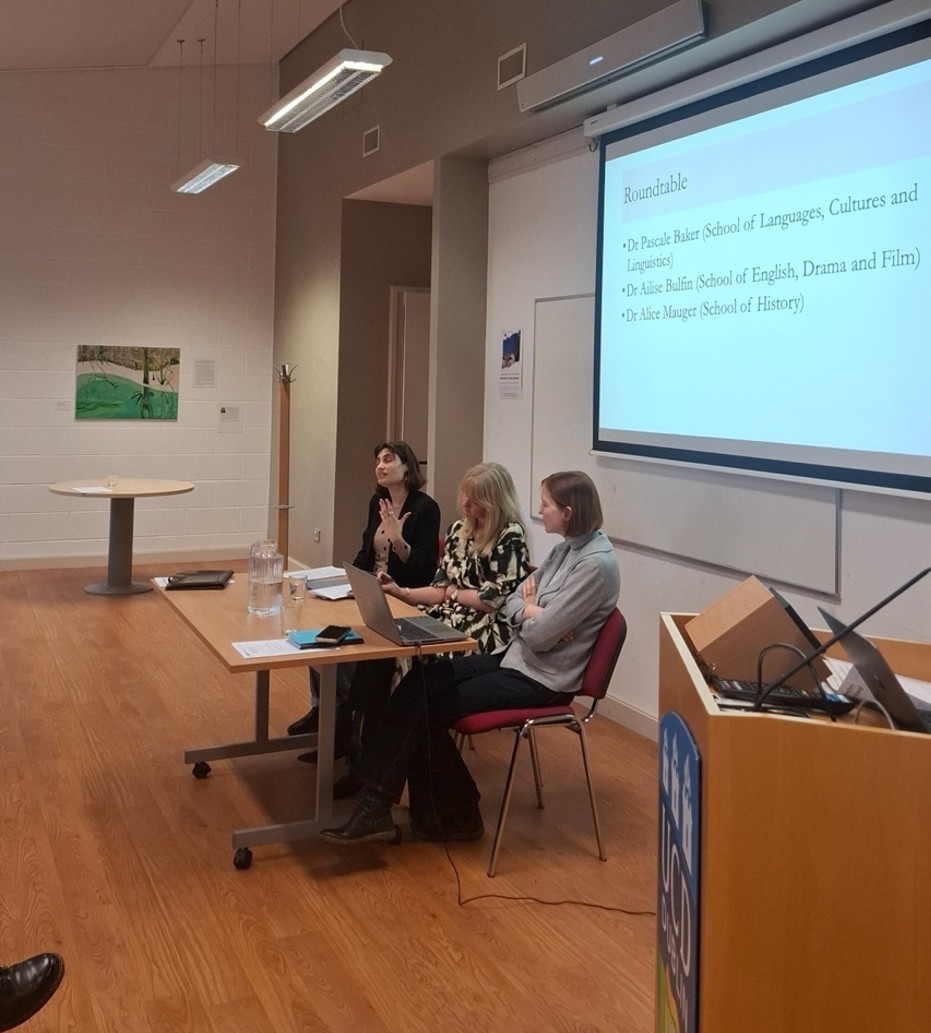
Capturing the interdisciplinary aspect of the health humanities, several disciplines were represented throughout the afternoon, including the School of History, the School of Languages, Cultures and Linguistics, the School of English, Drama and Film, and the Centre for Cultural Analytics. This made for a fruitful and generative conversation, in which we reflected on the role of the arts and humanities within approaches to the reduction of violence and its health implications. We concluded that the arts and humanities help to uphold the ambiguities and inconsistencies of certain ideas and narratives, providing important nuance, as well as hope, in the pursuit of healthier communities.
Stories of Violence and Health, Then and Now
I am also interested in learning more about public opinion on the role of language and storytelling within understandings of violence as a public health issue. In November 2025, I hosted an event in Reading (England) for professionals working in the areas of violence reduction and (public) health. I worked with Dr Kate Mattacks, a therapeutic writing practitioner, to develop creative writing activities that brought together some of the Victorian sources I am working with alongside public health approaches to violence in the twenty-first century.
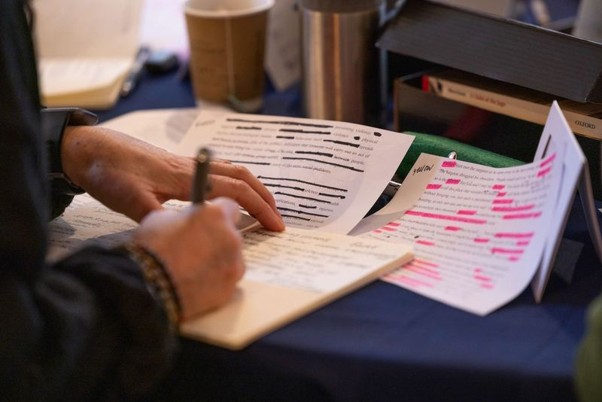
In one of the activities, we created an erasure poem: a technique that involves taking an extract from a book or essay and asking participants to erase words with a black marker or highlight words with a highlighter (as you can see in the photo here). Participants then create a poem from the words that were left behind after the erasing process or from the words they had highlighted. Alongside extracts from articles and blogs advocating for the public health approach to violence, Kate and I chose extracts from a novel I am writing about, Arthur Morrison’s A Child of the Jago (published in 1896), which follows a young boy navigating life in a London slum. The erasure poems that each participant created emerged from the nineteenth-century and twenty-first-century sources in tandem, bringing the past into dialogue with the present. One attendee wrote that the workshop’s activities had shown them “the power and importance of language … in shaping perception and understanding, and therefore the response”.
These events show the value in bringing people together to reflect on the importance of the arts and humanities in tackling complex public health issues like interpersonal violence. When it comes to solving public health crises, language and the stories we tell matter.