Understanding Teen Mental Health in Ireland Today: New research
Posted: 25 August, 2026
In this blog, Dr. Niamh Dooley tells us about her DOROTHY funded research revealing current trends in adolescent mental health in Ireland, highlighting rising rates of poor mental health, self harm, and suicide attempts, the heightened risks faced by specific groups, and the urgent need for better resourced youth mental health supports.
My DOROTHY fellowship is aimed at understanding current trends in adolescent mental health better. Studies from multiple countries including the UK and USA suggests there has been a deterioration in adolescent mental health. The goal of my recent DOROTHY-funded publication was to see if the same patterns could be seen in Ireland.
Using surveys from over 20,000 teenagers (aged 15–19) across six counties in Ireland, we investigated national trends in adolescent mental health, self‑harm, and suicide attempts. What we found has added fuel to an ongoing national conversation on unmet demand and wait lists for mental health supports for adolescents.
The findings
Arguably the most valuable contribution of this study was the updated national estimates on adolescent mental health in Ireland, which can be used by community health services and schools to anticipate demand for support, and design services accordingly:
• One in five young people said they considered their mental health to be “bad” or “very
bad”
• One in eight reported repeated self-harm (defined as 5 or more lifetime episodes).
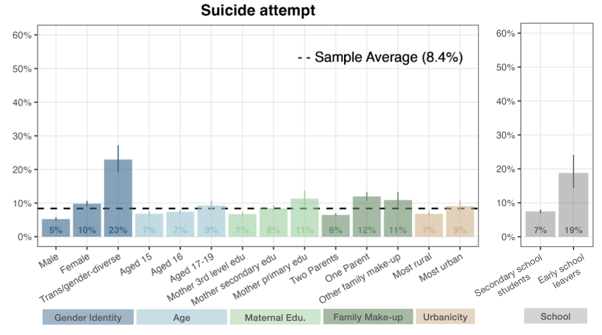
• One in twelve had made a suicide attempt in their lifetime.
These estimates suggest that in a typical classroom of 25 senior‑cycle students: five will have poor mental health, three will have repeatedly self‑harmed, and two will have attempted suicide. But it’s important to remember these are averages– estimates are likely lower in all-boys schools, higher in all-girls schools, and in Youthreach centres. And we must also remember that some groups might be more likely to under-report these types of distress, due to stigma or other cultural values.
We also found some evidence of changing prevalence:
• Rates of repeated self‑harm have rose from 9.7% during the pandemic to 11.1% two
years later.
And we found that not all groups of adolescents shared the same level of “risk” when reporting on their mental health, history of self-harm and suicide attempt:
• The highest risk groups include trans and gender‑diverse young people, and early school leavers.
Identifying high-risk groups is key to reducing risk on a population level—we need both targeted interventions that are tailored to the needs of these specific groups, and universal interventions that can be rolled out on a broader scale and prevent poor mental health from escalating.
How the media covered it
1. National newspaper coverage
I spoke with Eilish O’Regan, journalist with the Irish Independent who published an exclusive report on the study. Eilish linked the findings with ongoing pushes for reforms to youth mental health services. The article mentions the Oireachtas Health Committee the day before the study publication (28 Jan 2026) where Hannah Ní Ghiolla Mhairtín, spokeswoman for Families for Reform of CAMHS, spoke of the struggles of parents of children with suicidal ideation or self-harm who could not access support from youth mental health support services.
2. RTÉ Radio 1 interview
I spoke with RTÉ Radio 1’s Colm Ó Mongáin on Drivetime about what these numbers mean for young people, families, and services.
During the interview, we discussed:
• Why repeated self‑harm might be increasing
• Why students in Youthreach centres might have poorer mental health than those in traditional secondary schools
• The complex risk factors that might make transgender and gender-diverse more prone to poor mental health and what can be done to support them
• Whether social media use can help explain these trends
Listen in to the 8-minute interview here.
What next
Our results show that many teenagers in Ireland experience psychological distress, as illustrated through their reports of poor mental health, self-harming behaviours, and past suicide attempts. This will be unsurprising to many in the Government and civil society, who have been advocating for greater funding and capacity in CAMHS, and other community-level supports, for many years.
But we hope this study will support these actions in several ways:
1. Sustained political attention on this issue. Our findings show that rates of self-harm and suicide attempt are higher than they were 10 years ago, and rates of self-harm have been rising, at least up to 2023, meaning we cannot get complacent about service improvement
2. Helpful targets for community-based services. Schools and community-based mental health supports can use these statistics to advocate for resources and funding. For instance, mental health support personnel in schools and primary care health centres are more likely to experience 10% of its adolescent populations seeking support for their mental health, rather than the 1-2% target originally proposed to be captured by CAMHS
3. Trans and gender‑diverse adolescents and early school leavers were particularly likely to report distress, suggesting a need for carefully designed, inclusive supports for these groups.