Why Cross-National Data and Advanced Statistics Matter for Public Health Research
Posted: 23 July, 2026
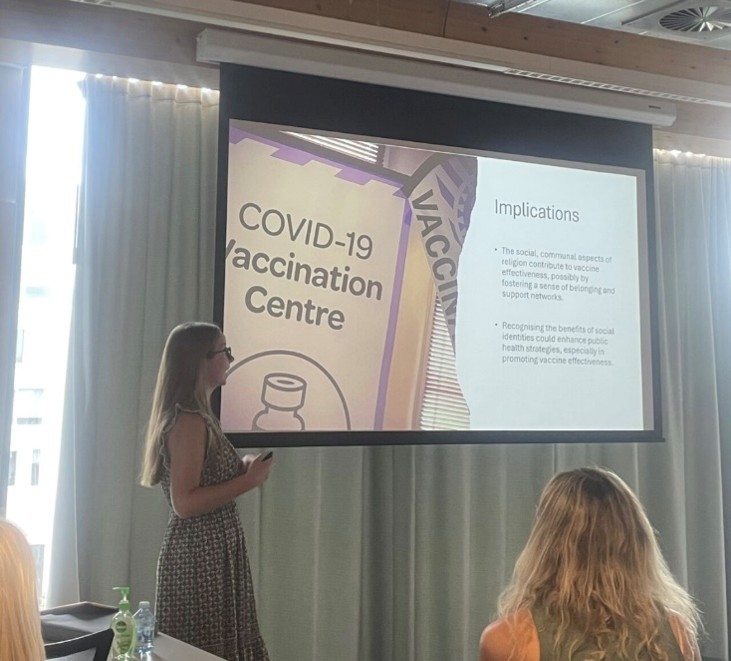
In this blog, Dr. Aoife Marie Foran tells us about using cross national European Social Survey data and advanced statistical modelling during their DOROTHY Fellowship to uncover how long COVID is unevenly distributed across marginalised groups, highlighting the structural inequalities that shape health outcomes across countries.
One of the biggest challenges in public health research is that many of the problems we seek to understand are global in nature, yet much of the evidence we rely on still comes from studies conducted in a single country. Issues such as long COVID, vaccine hesitancy, health inequalities, and chronic disease do not stop at national borders. To capture this wider reality, researchers need data that reflect the diversity of social and political contexts in which people live. Cross-national datasets such as the European Social Survey (ESS) help to bridge this gap. The ESS is one of the world’s most comprehensive social science surveys, collecting high-quality, representative data from more than thirty European countries. This makes it possible to move beyond local explanations and to test whether patterns observed in one setting reflect broader social processes that operate across different political, economic, and cultural systems.
This was a central motivation behind my DOROTHY Fellowship project. Over the past year and a half, I have used data from the ESS to examine long COVID at a population level across Europe. My research explores how social factors, such as group membership, discrimination, and social positioning, shape the likelihood of experiencing persistent COVID symptoms. Working with cross-national data allowed me to test whether these patterns were specific to particular countries or whether they emerged consistently across Europe. What I found was that long COVID is not evenly distributed across society. People who belong to marginalised or discriminated groups were more likely to report persistent symptoms, even after accounting for age, gender, vaccination status, and pre-existing health conditions.
Importantly, these inequalities appeared across multiple countries. This suggests they cannot be explained by national healthcare systems or local policies alone, but reflect deeper structural disadvantages that cut across societies.
However, meaningful insights from cross-national data require more than large sample sizes. One of the most important aspects of my fellowship was upskilling in advanced statistical methods, particularly multilevel modelling, which I undertook during my outgoing phase at the University of Queensland, Australia. Multilevel modelling is designed for data in which individuals are nested within larger contexts, such as countries or regions. This approach makes it possible to separate individual-level effects from contextual ones. Instead of asking only who is at higher risk, we can also ask how much of that risk is shaped by the social environments people live in. In my research, this meant examining how inequalities in long COVID operate at both personal and structural levels, and whether these patterns were consistent across countries or varied by national context.

From a public health perspective, this distinction is crucial. While individual behaviours and lifestyle factors matter, they do not fully explain why some groups are more exposed to poor health than others. Structural forces such as discrimination, social exclusion, and unequal access to resources play a powerful role. Multilevel modelling helps make these influences visible and strengthens the case for policy interventions that go beyond individual-level solutions.
One of the most valuable outcomes of my DOROTHY Fellowship so far has therefore been learning how to combine cross-national data with advanced statistical modelling to generate evidence that is both scientifically rigorous and socially meaningful. This approach allows public health research to better reflect the complexity of real-world health problems and to produce findings that are relevant not only for academics, but also for policy design and societal impact.