Low fertility research across histories of biology and demography 1920s/2020s
Posted: 16 February, 2026
Dr. Rebecca Close tells us about recent conference presentations and public engagement workshops organised in Spain between June-October 2025.
Time-lapse microscopy and lapses in time
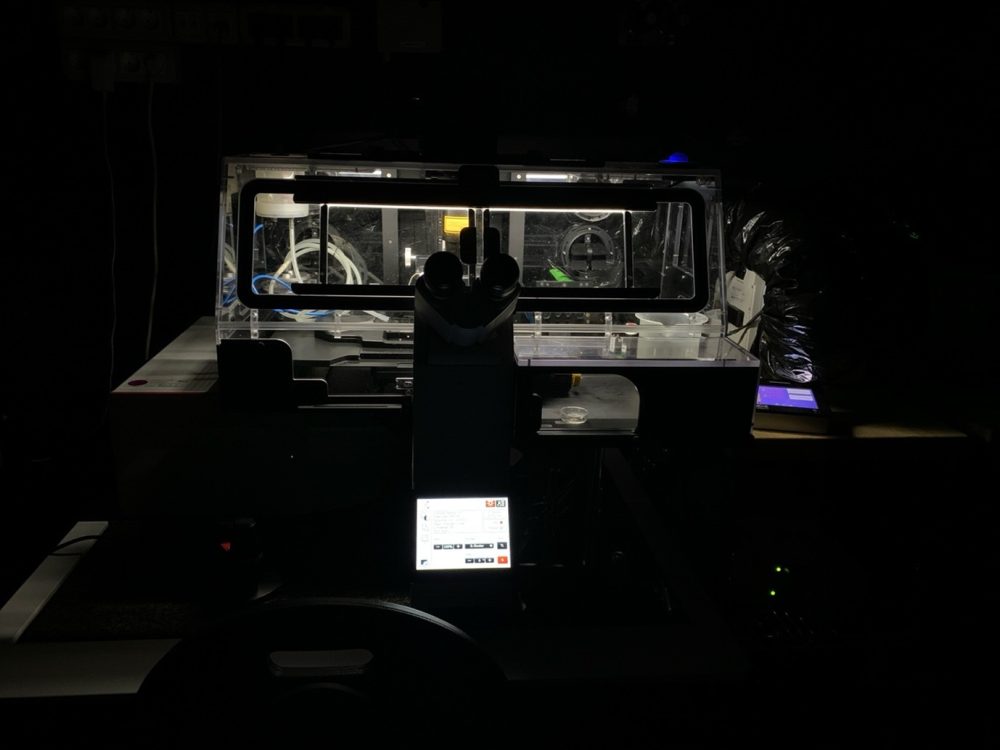
When time-lapse microscopy is used in a cell biology lab today, a sample of cells is placed in culture medium and positioned before the lens. Some units have built-in incubators with a platform that moves the cells around under the camera and software that automates the intervals between each snapshot. In the oocyte biology experiments I observed as part of this project’s lab ethnography, the interval between each image was about 25 minutes. When these images are stitched together into a digital video, 15 hours of cellular life becomes 2 seconds, making changes in the cell easier to see and analyse. Historians might also be thought to work in a mode akin to time-lapse: they offer detailed descriptions of particular moments in the past so that these can be compared and analysed against others.
From lab ethnographies to archival research
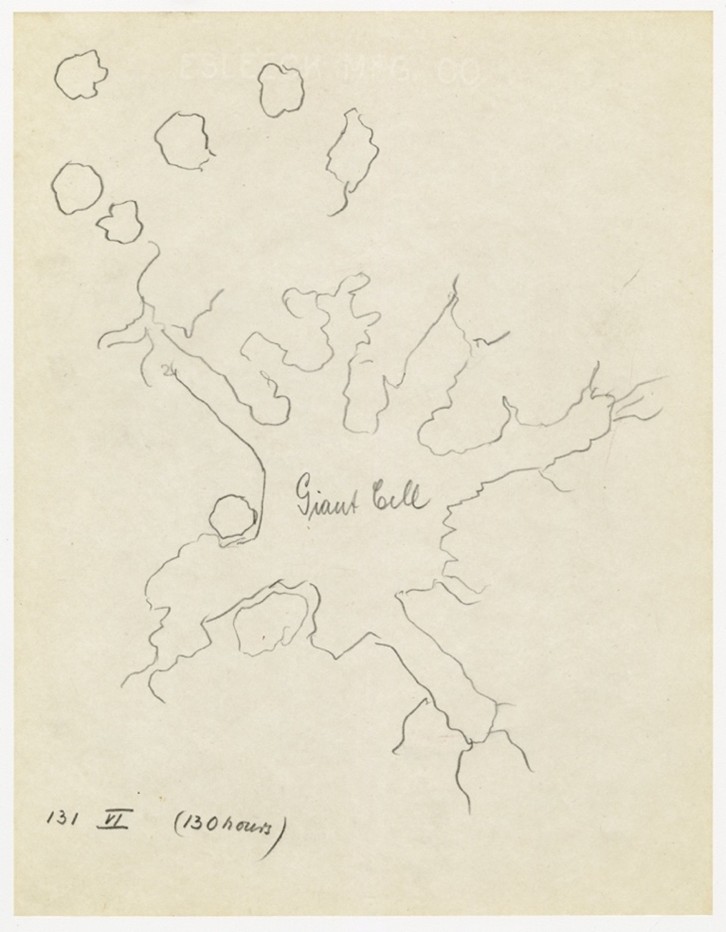
This research investigates how scientists use time-lapse microscopy to study reproductive cells today in the context of reports of fertility decline today, while also examining the first cell-culturing and time-lapse techniques at the beginning of the 20th century. Among other cases, I have been revisiting the early writings and drawings of the French surgeon Alexis Carrel, consulting collections at the Rockefeller Archive Center, the Wellcome Collection, and Georgetown University Special Collections. After developing cell-culturing techniques in the 1920s in the U.S., Carrel returned to occupied France in 1941 to direct France’s first public Eugenics institution, which conducted studies of ovulation at local hospitals and carried out demographic research on low fertility.
While this has little to do with the way reproduction research is conducted today, it offers an intriguing snapshot in time for considering how biological experimentation in the lab may have informed demographic crisis concerns —and how studying life in vitro may have shaped imaginaries of the population as a controlled environment into which government policy intervenes.
Workshops and reading groups
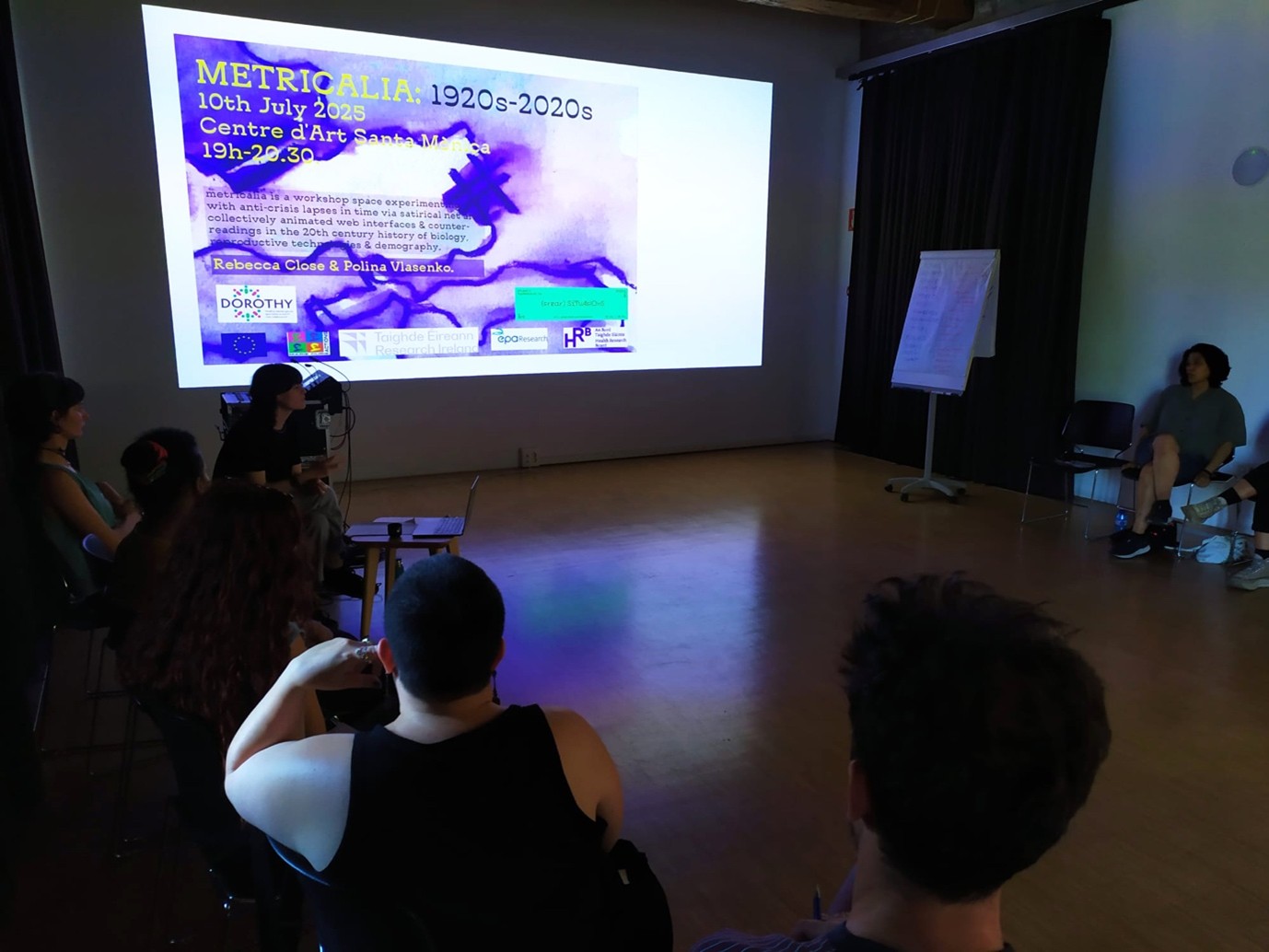
The workshop and reading group programme “Metricalia” was conceived as a multilingual space for sharing my research materials with artists, researchers, and cultural workers in Barcelona. The first session took place at the Arts Santa Mònica Museum as part of the curatorial programme “Crear Situaciones”. In groups, we excerpted quotes from archival documents relevant to the intersecting 20th century histories of biology and demography and posted them on an animated “metricalia” website. This enabled the comparison of population decline narratives across different national contexts, including Britain, France, Italy, Catalunya, and the Soviet Union.
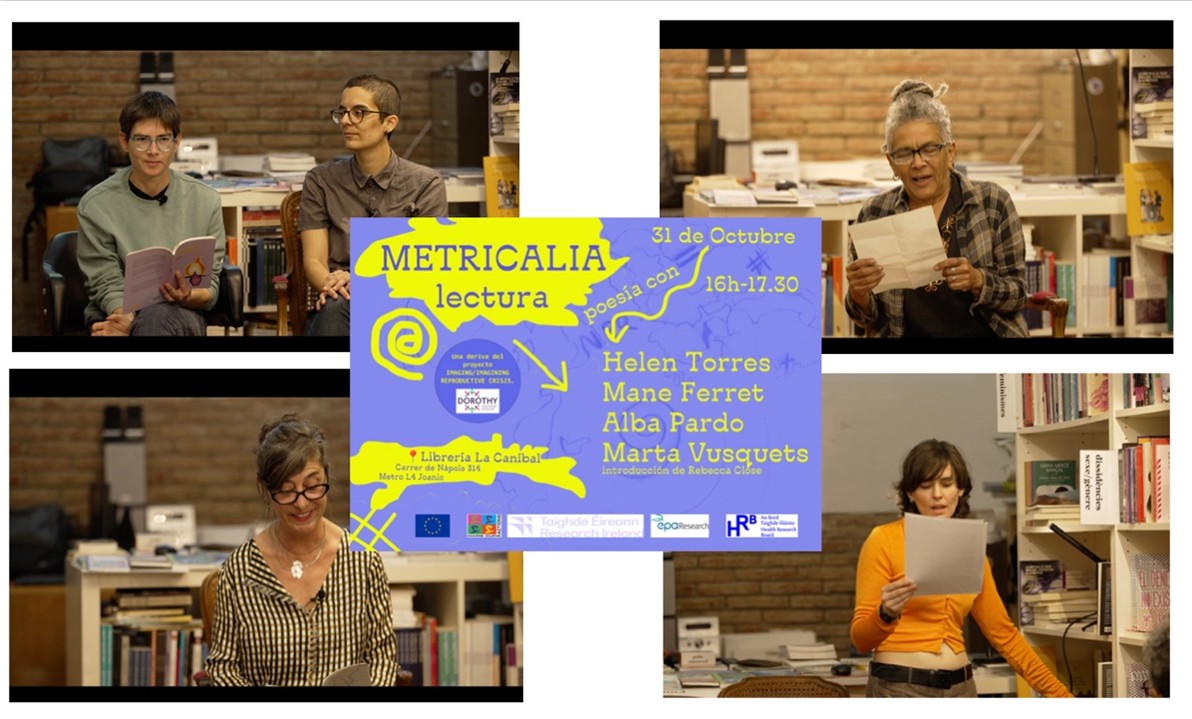
Metricalia continued at La Caníbal bookshop, where invited guest experts Jaume Valentines, Ainhoa Nadia Douhaibi, Jesús Jelen, Polina Vlasenko and I deepened the combined historical and theoretical lens for analysing the emergence of demographic crisis discourses through short talks. Metricalia concluded with readings that explored the other side of the metrical from a poetic perspective, with contributions from guest writers and poets Alba Pardo, Marta Vusquets, Mane Ferret and Helen Torres. (Image 4).
Connecting at conferences
In September 2025, I presented a paper that combined the archival and lab ethnography aspects of this project on a panel at the British Society for Population Studies titled “Public Concern about Low Fertility: the 1920s and 2020s.” The panel adopted a kind of time-lapse/lapse-in-time approach as speakers compared low-fertility discourses from the early 20th century with those of the present, examining how public concern about fertility decline appears and reappears over time. The keynote plenary, delivered by Stuart Gietel-Basten, emphasised the need for policies addressing population decline that center reproductive choice, warning that fertility targets as a solution for low fertility ultimately pose health risks. Getting to connect with other researchers working on reproductive crisis at this conference and others, such as the IV Reproductive Mobilities conference at the Universidad Autonoma Barcelona in June, was a highlight of the DOROTHY fellowship in 2025.