Dr. Amanda Lubit: Exploring the Connection between Pandemics and Mobilities
Posted: 23 December, 2025
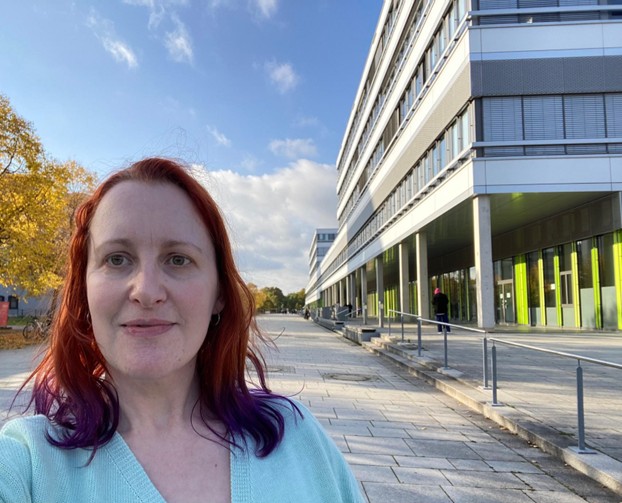
In October I was invited to participate in a workshop at Bielefeld University (Germany) on how pandemics affect people’s mobilities. It is part of a larger project to release an edited volume on the same subject in 2026, edited by Amrita Datta (Bielefeld University), Jonathan Ngeh (University of Cologne) and Arani Basu (Krea University). It was wonderful to connect with fellow authors from a range of countries and institutions, all working on similar issues yet with different perspectives. I was also able to get feedback on my own research and writing, which was overwhelmingly positive with other authors appreciating that my paper shows an example where something good came out of the pandemic.
For this workshop and my contribution to the upcoming book, I explore how the pandemic acted as a mobility catalyst, inspiring new creative forms of movement and connection. My research focuses on how lockdowns prompted a group of women refugees and asylum seekers to mobilise care and solidarity in innovative and complex ways.
Mobilities refer to the way people, things, information, ideas and more move. These movements occur at different scales and can take many forms. The easiest mobilities to understand are physical mobilities where people and objects move from one place to another (like the large-scale act of migration from one place to another, or the small scale act or walking from one place to another in your own town). During the pandemic, physical mobility was significantly disrupted and constrained by lockdown policies. However, other types of mobilities continued to take place and some even flourished. For instance, online mobility allowed people to connect with one another across significant distances. In my work I also look at social mobilities (the creation and maintenance of meaningful social connections), sensory mobilities (sensory perception in connection with other people, places and things), and existential mobilities (creating meaning and aspirations for the future). My chapter and presentation on this topic are titled: “‘It was obvious that food was a big problem’: Mobilising Care Through Food During and After the Pandemic.”
Although COVID-19 lockdowns were profoundly difficult for everyone, they were especially harsh for asylum seekers and refugees, who already lacked access to basic necessities—including adequate, healthy food. Yet when faced with these conditions, my participants demonstrated resilience and creativity by building connections and community. I examine these acts through the role of food. Food takes on many roles. It is a need, a necessity, and a right; yet it also became an emergency in the first days of the pandemic when food banks closed and supermarkets experienced shortages. I argue that food is also a form of care—a way for people to connect and provide for one another. To demonstrate this, I use a longitudinal approach, combining my previous research (May 2019 to September 2020) with my current research period (2024–2026). This perspective allows me to explore how women care for each other across time and space, adapting their strategies to changing needs and conditions, such as those created by the pandemic.
Additional Information:
My DOROTHY research examines the crises impacting upon the lives of refugee and asylum seeking women in Ireland. It builds upon 18 months of research with migrant women in Belfast, from 2019-2020. For more detailed information on these issues, please see the following publications (open access):
Valuing women’s spaces and communities: Refugee integration in hostile environments by Amanda Lubit
Life as a migrant Muslim woman in sectarian Northern Ireland by Amanda Lubit
Link to Profiles:
Amanda Lubit on LinkedIn, Researchgate and BlueSky